The short answer
AOB, the acceleration (accelerated) of benefits: part of a life policy's death benefit is paid to you early, while you are alive, to cover qualifying long-term care. Every dollar paid reduces the death benefit your family would receive. COB, the continuation of benefits: an added feature that keeps paying monthly care benefits after the whole death benefit has been used, usually from a separate pool. Many carriers call it an "extension of benefits" (EOB), so check the exact name in your policy.
Why the acronyms are confusing
AOB and COB are shorthand, not universal terms. Some carriers use them on every illustration, others spell out "accelerated death benefit" or "extension of benefits." And the same letters mean other things in health insurance. When someone says "AOB" or "COB," ask which one they mean.
| Letters | In a hybrid long-term care policy | In health insurance billing |
|---|---|---|
| AOB | Acceleration of benefits: the death benefit pays for care | Assignment of benefits: you ask the insurer to pay the provider directly |
| COB | Continuation of benefits: care benefits keep paying after the death benefit is used | Coordination of benefits: which of two health plans pays first |
| EOB | Extension of benefits: another name for continuation | Explanation of benefits: the statement showing how a claim was paid |
| ADB | Accelerated death benefit: the same idea as AOB |
This page uses AOB and COB in the long-term care sense.
AOB: using the death benefit for care
With an accelerated benefit, you do not buy a separate pool of long-term care money. You use some or all of the life insurance death benefit, and the amount paid for care reduces what is left at death. For example, with a $500,000 death benefit and a 50% acceleration, you could access up to $250,000 for care. Care-focused riders generally pay monthly instead of a lump sum.
Two kinds of rider
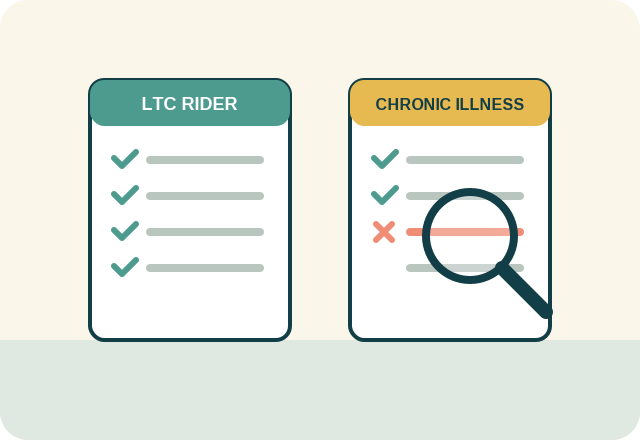
| Long-term care rider | Chronic illness rider | |
|---|---|---|
| Tax code | Section 7702B (qualified long-term care) | Section 101(g) (accelerated death benefit) |
| May be marketed as long-term care coverage | Yes | No |
| How it pays | Reimbursement or indemnity (fixed amount) | Indemnity, with limited restrictions on how you use the money |
| Typical trigger | Needs help with activities of daily living or has cognitive impairment, with a plan of care | A licensed health care practitioner certifies chronic illness |
Payments from chronic illness riders are subject to an IRS annual per diem limit that is set for all long-term care and chronic illness contracts together, so amounts above the limit, or above actual care costs, may be taxable. Ask a tax professional before relying on them. See the chronic illness vs. long-term care rider comparison.
COB: what happens after the death benefit is gone
A life policy with an accelerated benefit alone stops paying for care once the death benefit is used up. A continuation or extension feature is designed for the longer claims: it continues monthly care benefits after the death benefit has been fully accelerated. It typically creates a separate pool of long-term care dollars, so it is often what makes a combination policy behave more like true long-term care insurance. If you never use up the benefits, there may still be a final death benefit.
Example: a OneAmerica Asset Care style plan with a 3-year AOB and unlimited COB
OneAmerica's Asset Care is a well-known example of a whole life policy that uses these exact terms. Its acceleration of benefits (AOB) rider pays long-term care benefits from the death benefit, and its optional continuation of benefits (COB) rider, available for an additional cost, can continue benefits for a set number of years or for life. Here is how a plan with a 3-year AOB and unlimited (lifetime) COB would work.
Hypothetical illustration, not a quote. Maria, age 55, has a whole life policy with a $360,000 face amount. Her AOB pays up to $10,000 a month for care, so the death benefit lasts 36 months, or 3 years ($360,000 divided by $10,000). Once the face amount is used up, her lifetime COB rider keeps paying up to $10,000 a month for as long as she qualifies for care. If she never needs care, her family receives the $360,000 death benefit. If she needs care for 3 years, the death benefit is gone and the COB takes over. If she needs care for 10 years, the AOB pays for 3 and the COB for 7.
- The COB starts only after the AOB is used. It begins once the policy face amount is exhausted.
- "Unlimited" still has a monthly cap. It means no end date, not unlimited dollars per month.
- It costs extra. The COB is an optional rider with its own premium, so not every illustration includes it.
- AOB lengths come in set options. OneAmerica's published options for the Asset Care base policy are 25, 33 or 50 months, so a real policy's AOB may be 33 months rather than exactly 36. Products and versions change, so use the carrier's current illustration.
Not every carrier offers a lifetime continuation. Others cap it at a few years. Whatever the name, ask how long the continuation lasts and what it costs.
How the pieces fit together
- Waiting period: you pay for care yourself until the elimination period ends.
- Accelerated benefit: monthly benefits are paid from the death benefit, and the death benefit shrinks.
- Continuation or extension: if elected, monthly benefits continue from a separate pool.
- Remaining death benefit: whatever is left, if anything, goes to your beneficiaries.
Questions to ask before you buy
- Is this a 7702B long-term care rider or a 101(g) chronic illness rider?
- What is the maximum monthly benefit, and does it reimburse expenses or pay a set amount?
- Is there a continuation or extension of benefits? How long does it last, and what is the separate pool?
- Does the benefit grow with inflation? Requirements to offer inflation protection generally do not apply to an accelerated death benefit for long-term care.
- What is the waiting period, and what must the plan of care include?
- How is the extension priced, and is the premium guaranteed?
Not tax or legal advice. Product names and terms differ by carrier and state. The contract and the carrier's written illustration control.
Common questions
Are AOB and COB standard industry abbreviations?
Not universally. OneAmerica, for example, uses AOB and COB on its Asset Care materials. Other carriers say "accelerated death benefit" (ADB) and "extension of benefits" (EOB). In health insurance the same letters can mean assignment of benefits and coordination of benefits. Ask the carrier to define each term in writing.
Does using an accelerated benefit reduce the death benefit?
Yes. Benefits paid for care are deducted from the death benefit, so your beneficiaries receive less.
Is an accelerated death benefit rider a substitute for long-term care insurance?
Not by itself. These riders can help pay for care but they do not offer the comprehensive coverage of a dedicated policy. A continuation or extension feature narrows that gap for long claims.
Are the benefits taxable?
Benefits from a qualified long-term care rider are generally tax-free within IRS limits. Chronic illness rider payments are subject to the per diem limit and some tax uncertainty, so confirm with a tax professional.