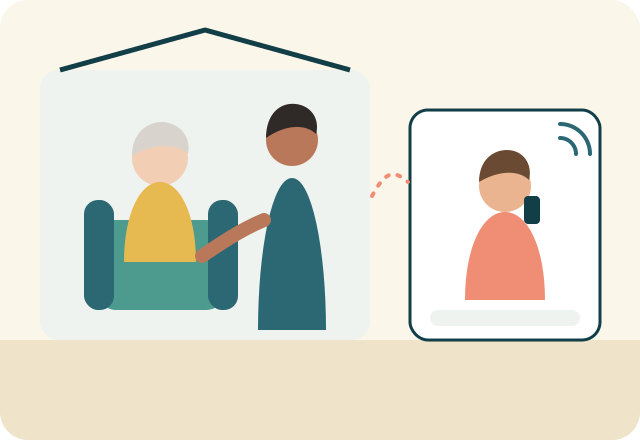
The short answer
Adult children who cared for a parent often say the hardest part wasn't the money alone. It was being the plan. When a parent had long-term care insurance, the family usually had more choices and less strain. Many caregivers decide they don't want their own children to go through the same thing, and start planning in their 40s and 50s, while coverage is easier to qualify for.
About these stories: they're composites based on common situations families describe, not real clients. Names and details are made up.
The daughter who lived 15 minutes away
Nearby · parent had no insurance
Karen's mother had a stroke at 81. Karen lived closest, so she became the plan. At first it was a few visits a week. Within months it was every morning before work and every evening after.
Her mother had a modest pension and about $150,000 in savings. Paying for home care meant watching that money disappear, so the family held off. Karen cut back to part-time work. When her mother needed full-time help two years later, the savings went quickly, and the family went through the Medicaid process.
What Karen did next: at 56, she bought a hybrid life and long-term care policy. Her reason was simple: she didn't want her son to give up his job for her.
The son who managed care from three states away
Long-distance · parent had insurance
David lived in Arizona. His father, in Ohio, developed Parkinson's disease. Years earlier, his father had bought a long-term care policy with inflation protection.
When his father needed help with bathing and dressing, David called the insurance company. The policy's care coordinator helped find a home care agency near his father's house. After the waiting period, benefits paid most of the cost of the aides. David flew in every few months, but he didn't have to quit his job or move.
What David did next: at 52, he and his wife each bought coverage. His father's policy hadn't just paid bills. It had given the family someone to call.
The sandwich-generation couple
Sandwich generation · parent had no insurance
Lisa and Mark had two kids in high school when Mark's mother was diagnosed with Alzheimer's disease. With no policy and limited savings, she moved into their home.
For three years, Lisa drove carpools, worked full-time, and managed her mother-in-law's medications and appointments. They paid for adult day care so they could both keep working, and dipped into the college fund to do it. When Mark's mother began wandering at night, they moved her to memory care, which her savings and their own money paid for until she qualified for Medicaid.
What Lisa and Mark did next: at 49 and 51, they set up a plan of their own and talked with their kids about it. Having cared for everyone at once, they didn't want their children in the same spot.
The sister who lived far away, and the brother who didn't
Nearby and long-distance siblings · parent had no insurance
When their father began falling, Tom lived nearby and did nearly everything: grocery runs, doctor visits, the 2 a.m. calls. His sister Jen lived in California and sent money when she could.
With no plan and no policy, every decision turned into a family debate: whether to hire help, whether Dad should move, and who was doing their share. By the time their father moved to assisted living, Tom was exhausted and the siblings were barely speaking.
What they did next: both bought coverage in their early 50s. The care had been hard, but what nearly broke the family was not having a plan.
The parents who had a policy, but not enough
Nearby · parent had an older policy
Mike's parents bought long-term care insurance in the 1990s with a small daily benefit and no inflation protection. When his mother needed care 25 years later, the policy paid, but only a fraction of what care cost by then.
It still helped. The rest came from savings and from Mike and his wife pitching in.
What Mike did next: at 58, he bought coverage with compound inflation protection. His mother's policy had taught him that the benefit has to keep up with costs. See questions to ask about benefits and inflation.
What these families have in common
Someone becomes the plan
Usually the closest child.
Without a plan, the person who lives nearest often takes on the most work, sometimes at the cost of their job and health.
Distance doesn't remove the stress
It changes it.
Long-distance children handle calls, bills, and guilt, and often feel they're never doing enough.
A policy changes the conversation
From "can we afford it" to "what's best."
Families with coverage generally had more choices about where care happened and who provided it.
If you've been through it, here's what to do now
- Look at your own situation while you're healthy. Coverage requires health approval, and premiums are generally lower the younger you buy. See long-term care insurance by age.
- Decide where you'd want care, and who you would and wouldn't want doing it.
- Compare traditional and hybrid options. Hybrid policies return a death benefit if care is never needed. See hybrid life and long-term care.
- Get your documents in order: a power of attorney and health care proxy. See estate planning for long-term care.
- Tell your children. A short conversation now can spare them the guesswork you faced.
Still caring for a parent now?
If you're in the middle of it, start with what to do after a parent's fall, a family meeting agenda, and free local resources. If your parent has a policy, see how to file a claim.
Common questions
I took care of my parent. Should I buy long-term care insurance?
Many people who have been caregivers decide to plan for themselves, because they've seen the cost to the family firsthand. Whether insurance fits depends on your age, health, savings, and who could care for you. A specialist can compare options with you.
What age should adult children buy long-term care insurance?
Many people look at coverage in their 50s. Buying earlier generally means lower premiums and a better chance of health approval, while buying later means fewer years of paying premiums.
How can I care for a parent who lives out of state?
Long-distance caregivers often rely on a local care manager or home care agency, the parent's Area Agency on Aging, and, if the parent has a policy, the insurer's care coordination services. Call the Eldercare Locator at 1-800-677-1116 to find local help.
What is the sandwich generation?
Adults who are caring for an aging parent while still raising or supporting their own children.